I never meant to read this short story.
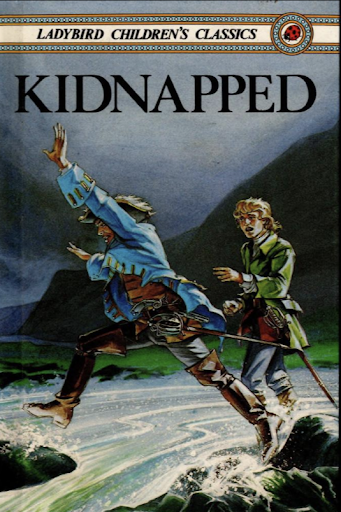
I picked up Stevenson’s “Dr Jekyll and Mr Hyde” when I saw it for sale in a charity shop in Calahonda, in Spain. I’d previously read “Kidnapped” and “Treasure Island” while in Morocco, in late 2025. Really enjoyed both of them, “Kidnapped” especially. It was a favourite when I was a child, although I only ever read the Ladybird abridged version:
One of those books I read over and over again, as it had some brilliant illustrations.
It was nice to return to Stevenson years later, and find him just as interesting a writer as I’d found him before, in new ways.
Dr Jekyll and Mr Hyde was fine, but quite short, so I carried on reading the next story in the volume, which I’d never heard of before.
It’s less than 70 pages long, and doesn’t really work as a story - lacks the tight plotting that makes Stevenson so enjoyable to read. But it features some outstanding sections, some that I could not quite believe Stevenson had written, as they felt very unusual and “animist” to me. As I read, particularly the opening sections, I had this odd feeling of the story reading me, producing in every next line what I was thinking about internally.
I've pulled out a few lines and longer quotes below:
“He was sure he had seen such a look before, and yet he could not remember how or where.”
There’s so much intrigue going on in this early description of the boy. He becomes a very central character in the story, but he’s also constantly “occluded”, in the sense that you don’t get a good handle on him.
It puts me in mind of Bolano. It’s very assured, and detailed, yet slippery, then goes somewhere unexpected.
“It was the boy who took the Doctor’s fancy. He had a great arched skull, the forehead and the hands of a musician, and a pair of haunting eyes. It was not merely that these eyes were large, or steady, or the softest ruddy brown. There was a look in them, besides, which thrilled the Doctor, and made him half uneasy. He was sure he had seen such a look before, and yet he could not remember how or where. It was as if this boy, who was quite a stranger to him, had the eyes of an old friend or an old enemy. And the boy would give him no peace; he seemed profoundly indifferent to what was going on, or rather abstracted from it in a superior contemplation, beating gently with his feet against the bars of the chair, and holding his hands folded on his lap. But, for all that, his eyes kept following the Doctor about the room with a thoughtful fixity of gaze. Desprez could not tell whether he was fascinating the boy, or the boy was fascinating him. He busied himself over the sick man: he put questions, he felt the pulse, he jested, he grew a little hot and swore: and still, whenever he looked round, there were the brown eyes waiting for his with the same inquiring, melancholy gaze.
At last the Doctor hit on the solution at a leap. He remembered the look now. The little fellow, although he was as straight as a dart, had the eyes that go usually with a crooked back; he was not at all deformed, and yet a deformed person seemed to be looking at you from below his brows. The Doctor drew a long breath, he was so much relieved to find a theory (for he loved theories) and to explain away his interest.”
“‘He is a little pagan,’ said the landlady. ‘For that matter, they are all the same, these mountebanks, tumblers, artists, and what not. They have no interior.’”
It just made me laugh… pagans/artists, lacking an interior… But you get a stronger sense here of what Stevenson is setting up… the good doctor, a rational man of science, nonetheless captivated by the little pagan.
“After he had watched a mile or so of the clear water running by before his eyes…”
Stevenson is difficult to quote in any succinct way, particularly in this short story. So much overlaps and runs on from previous sentences. But what I was grabbed by with this particular section, which is really the very next page from the previous quote, is this sense of the doctor as an animist… praying to the river. And I was also surprised with that particular phrase, of seeing a mile of water pass… It’s an unusual but absolutely correct way of explaining how attention works and how it can be shifted. The idea that the water is moving is obvious, but to state that a mile passes is an odd formulation that struck me.
“The morning after he had been summoned to the dying mountebank, the Doctor visited the wharf at the tail of his garden, and had a long look at the running water. This he called prayer; but whether his adorations were addressed to the goddess Hygieia or some more orthodox deity, never plainly appeared. For he had uttered doubtful oracles, sometimes declaring that a river was the type of bodily health, sometimes extolling it as the great moral preacher, continually preaching peace, continuity, and diligence to man’s tormented spirits. After he had watched a mile or so of the clear water running by before his eyes, seen a fish or two come to the surface with a gleam of silver, and sufficiently admired the long shadows of the trees falling half across the river from the opposite bank, with patches of moving sunlight in between, he strolled once more up the garden and through his house into the street, feeling cool and renovated.”
“It is quiet… and I have nothing to do; and then I feel as if I were good.”
You could say that one aspect of the story of “The Treasure of Franchard” is about the doctor, Desprez, becoming slowly more obsessed with the boy, Jean-Marie. But Jean-Marie is also a well-conceived character who has a habit of not saying very much at all, with words that really hit the mark when he does let them go. I don’t feel like he’s a typical Stevenson character.
While pairings of an older, flawed man and a younger, more intelligent/virtuous man are common (in both Treasure Island and Kidnapped), what’s odd here is the relative opaqueness of Jean-Marie.
“‘Aha!’ he said, stopping before him humorously, with a hand on either knee. ‘So we rise early in the morning, do we? It appears to me that we have all the vices of a philosopher.’
The boy got to his feet and made a grave salutation.
‘And how is our patient?’ asked Desprez.
It appeared the patient was about the same.
‘And why do you rise early in the morning?’ he pursued.
Jean-Marie, after a long silence, professed that he hardly knew.
‘You hardly know?’ repeated Desprez. ‘We hardly know anything, my man, until we try to learn. Interrogate your consciousness. Come, push me this inquiry home. Do you like it?’
‘Yes,’ said the boy slowly; ‘yes, I like it.’
‘And why do you like it?’ continued the Doctor. ‘(We are now pursuing the Socratic method.) Why do you like it?’
‘It is quiet,’ answered Jean-Marie; ‘and I have nothing to do; and then I feel as if I were good.’”
“Fix your mind on my example; despise riches, avoid the debasing influence of cities. Hygiene — hygiene and mediocrity of fortune — these be your watchwords during life!”
I always enjoy a line about distrusting money and cities…“When he was by himself, his pleasures were almost vegetable.”
Jean-Marie is beyond words, or does not need them. He’s more akin to a tree than he is to a human. He's almost a non-human person, as per animism.
“Convictions existed in him by divine right; they were virgin, unwrought, the brute metal of decision. He could add others indeed, but he could not put away; neither did he care if they were perfectly agreed among themselves; and his spiritual pleasures had nothing to do with turning them over or justifying them in words. Words were with him a mere accomplishment, like dancing. When he was by himself, his pleasures were almost vegetable. He would slip into the woods towards Acheres, and sit in the mouth of a cave among grey birches. His soul stared straight out of his eyes; he did not move or think; sunlight, thin shadows moving in the wind, the edge of firs against the sky, occupied and bound his faculties. He was pure unity, a spirit wholly abstracted. A single mood filled him, to which all the objects of sense contributed, as the colours of the spectrum merge and disappear in white light.
So while the Doctor made himself drunk with words, the adopted stable-boy bemused himself with silence.”
“Sneers and tears”
Prayers or laughter - those are your choices:
“...had I lived in the Middle Ages (I am heartily glad that I did not) I should have been an eremite myself — if I had not been a professed buffoon, that is. These were the only philosophical lives yet open: laughter or prayer; sneers, we might say, and tears. Until the sun of the Positive arose, the wise man had to make his choice between these two.”
“...the trees went by, looking on silently, as if they had something on their minds.”
Similar to the description of the river earlier, what I notice here most is Stevenson attributing personhood to the trees.
“...because they are painters, they are probably immoral… A man of imagination is never moral.”
The dangerous quality of the imagination! Indeed.
“In order to fill my outline of the robbery, I require a man likely to be in the forest idling, I require a man of education, I require a man superior to considerations of morality. The three requisites all centre in Tentaillon’s boarders. They are painters, therefore they are continually lounging in the forest. They are painters, therefore they are not unlikely to have some smattering of education. Lastly, because they are painters, they are probably immoral. And this I prove in two ways. First, painting is an art which merely addresses the eye; it does not in any particular exercise the moral sense. And second, painting, in common with all the other arts, implies the dangerous quality of imagination. A man of imagination is never moral; he outsoars literal demarcations and reviews life under too many shifting lights to rest content with the invidious distinctions of the law!’”
“A man who deals with money, my dear, is a man lost.”
As before, another line that made me smile.
“I think it must be your imagination. I thank my stars I have none.”
The perils of the imagination, again.